Wednesday, February 2, 2022

Garbage In, Garbage Out, Ch 16, class 6

 1. The method of preparing compost with the help of earthworms is called   (1)

(a) composting
(b) vermicomposting
(c) manuring
(d) decomposing

2. If you dump kitchen waste in a pit, it may, after sometime    (1)
(a) convert into compost
(b) convert into vermicompost
(c) remain as such
(d) remain forever in its dried form.

3. Which of the following activities does not reflect responsible behaviour with regard to waste disposal?   (1)
(a) Goods carried m paper bags or cloth bags.
(b) Waste collected in polythene bags for disposal.
(c) Waste separated into those that degrade and those that do not.
(d) Making handicrafts with used up notebooks.

4. Paheli gave the following ill effects of the practice of burning dried leaves and other plant parts.
(i) Burning degrades the soil.   (1)
(ii) Burning produces harmful gases/fumes.
(iii) Precious raw materials to obtain manure at a low cost is lost.
(iv) Lot of heat is generated unnecessarily.
The correct reasons of why we should not burn leaves are
(a) i, ii and iv only
(b) i, ii, iii and iv
(c) ii and iii only
(d) ii, iii and iv only.

5. A garbage collector separate items mentioned below in the garbage into red, green and blue containers for their transfer to landfill, composting pit, and recycling unit respectively.
Items:     (2)
(i) Plastic bags
(ii) Newspaper and journals
(iii) Screw and nuts
(iv) Vegetable peels
(v) Metal chips
(vi) Eggshells
Which item was transferred to which bin?
REDGREENBLUE
(a)(i) and (iv)(ii) and (iii)(v) and (vi)
(b)(i) and (iii)(ii) and (v)(iv) and (vi)
(c)(i), (iii) and (v)(iv) and (vi)(ii) only
(d)(i) and (v)(ii) and (iv)(iii) only
6. The steps required for conversion of kitchen garbage into manure are given below in a jumbled form.                                                   (1)
(i) Put garbage in a pit.
(ii) Cover the bottom of the pit with sand.
(iii) Cover the pit loosely with a gunny bag or grass.
(iv) Add worms.                
Which of the following shows the correct sequence of the above steps?
(a) (ii); (i); (iii); (iv)
(b) (i); (ii); (iii); (iv)
(c) (ii); (iv); (i); (iii)
(d) (iv); (i); (ii); (iii)

7. Read the items mentioned in columns-l and II and fill in the related process in column III.  (3)

Column IColumn IIColumn III
(a) Organic wasteEarthworms(i) ……………
(b) GarbageDig pit and fill with garbage(ii) ……………
(c) Old newspaperPaper bags(iii) ……………
8. Correct the definitions of certain terms given below by changing only one word.      (3)
(i) Compost: Substances converted into manure for use in industries.
(ii) Landfill: Garbage buried underwater in an area.
(iii) Recycling: Reuse of unused material in the same or another form.

9. Provide a suitable term that expresses the meaning of each of the following statements.     (2)
(a) Greeting cards made from newspaper.
(b) Contents of the waste bins.
(c) Worms converting certain kinds of waste into manure.
(d) An area where a lot of garbage is collected, spread out and covered with soil.

10.Put a tick (✓) against the garbage items given in Table 16.1 which could be converted into manure. Put a cross (X) against the others.                                (5)
Garbage ItemsMake manure or not
(i)Eggshells
(ii)Straw
(iii)Dry flowers
(iv)Pebbles
(v)Broken pieces of glass
(vi)Nails and screws
(vii)Plastic bangles
(viii)Leftover food
(ix)Steel broken vessel
(x)Dead animals

Friday, January 14, 2022

Friction (CH 12) and Sound (CH 13), CLASS 8

 1. A list of mediums is given below.

(i) wood

(ii) water

(iii) air

(iv) vacuum

In which of these mediums can sound travel?

(a) i & ii only

(b) i, ii & iii only

(c) iii & iv only

(d) ii, iii & iv only


2. The loudness of a sound depends on:

(a) its amplitude.

(b) its frequency.

(c) its time period.

(d) its speed.


3. Which of the following statements are correct?

(i) Sound is produced by vibrations.

(ii) Sound requires a medium for propagation.

(iii) Light and sound both require a medium for propagation.

(iv) Sound travels slower than light.

(a) i & ii only

(b) i, ii & iii only

(c) ii, iii & iv only

(d) i, ii & iv only


4. An object is vibrating at 50 hertz. What is its time period?

(a) 0.02 s

(b) 2 s

(c) 0.2 s

(d) 20.0 s


5. In order to reduce the loudness of a sound, we have to

(a) decrease its frequency of vibration of the sound.

(b) increase its frequency of vibration of the sound.

(c) decrease its amplitude of vibration of the sound.

(d) increase its amplitude of vibration of the sound.


6. The loudness of sound is determined by the

(a) amplitude of vibration

(b) the ratio of amplitude and frequency of vibration

(c) frequency of vibration

(d) product of amplitude and frequency of vibration


7. 1 hertz is equal to

(a) 1 vibration per minute

(b) 10 vibrations per minute

(c) 60 vibrations per minute

(d) 600 vibrations per minute


8. Pitch of sound is determined by its

(a) frequency

(b) amplitude

(c) speed

(d) loudness


9. Ultrasound has a frequency of vibration

(a) between 20 and 20,000 Hz

(b) below 20 Hz

(c) above 20,000 Hz

(d) between 500 and 10,000 Hz


10. 
Whenever the surfaces in contact tend to move or move with respect to each other, the force of friction comes into play

(a) only if the objects are solid.

(b) only if one of the two objects is liquid.

(c) only if one of the two objects is gaseous.

(d) irrespective of whether the objects are solid, liquid or gaseous.


11.  To sharpen the blade of a knife by rubbing it against a surface, which of the following will be most suitable?

(a) stone

(b) plastic block

(c) wooden block

(d) glass block


12. If we apply oil on door hinges, the friction will

(a) increases

(b) decreases

(c) disappear altogether

(d) will remain unchanged


13. Which of the following statements is incorrect?

(a) Friction acts on a ball rolling along the ground.

(b) Friction acts on a boat moving on water.

(c) Friction acts on a bicycle moving on a smooth road.

(d) Friction does not act on a ball moving through air.


14. A boy rolls a rubber ball on a wooden surface. The ball travels a short distance before coming to rest. To make the same ball travel longer distance before coming to rest, he may

(a) spread a carpet on the wooden surface.

(b) cover the ball with a piece of cloth.

(c) sprinkle talcum powder on the wooden surface.

(d) sprinkle sand on the wooden surface


15. In a large commercial complex, there are four ways to reach the main road. One of the paths has loose soil, the second is laid with polished marble, the third is laid with bricks and the fourth has a gravel surface. It is raining heavily and Paheli wishes to reach the main road. The path on which she is least likely to slip is

(a) loose soil.

(b) polished marble.

(c) bricks.

(d) gravel.


16. Two boys are riding their bicycles on the same concrete road. One has new tyres on his bicycle while the other has tyres that are old and used. Which of them is more likely to skid while moving through a patch of the road which has lubricating oil spilt over it?


17.  Imagine that an object is falling through a long straight glass tube held vertical; the air has been removed completely from the tube. The object does not touch the walls of the tube. Will the object experience any force of friction?


18. Lightning can be seen as the moment it occurs. Paheli observes lightning in her area. She hears the sound 5 s after she observed lightning. How far is she from the place where lightning occurs? (speed of sound = 330 m/s).


19. Boojho saw a cracker burst at night at a distance from his house. He heard the sound of the cracker a little later after seeing the cracker burst. Give the reason for the delay in hearing the sound.


20. A simple pendulum makes 10 oscillations in 20 seconds. What is the time period and frequency of its oscillation?

CLASS TEST CH - 11,12 (CLASS 6)

1 . Observe the picture given in fig 11.1 carefully.

NCERT Exemplar Solutions for Class 6 Science Chapter 11- image 1

A patch of light is obtained at B, when the torch is lighted as shown. Which of the following is kept at position A to get this patch of light?
(b) A glass sheet
(c) A mirror
(d) A sheet of white paper,

2. A student observes a tree given in figure through a pinhole camera. Which of the diagrams given in figures (a) to (d) depicts the image seen by her correctly?

NCERT Exemplar Solutions for Class 6 Science Chapter 11- image 2

NCERT Exemplar Solutions for Class 6 Science Chapter 11- image 3


3. Four students A, B, C and D looked through pipes of different shapes to see a candle flame as shown in fig 11.4.

NCERT Exemplar Solutions for Class 6 Science Chapter 11- image 4

Who will be able to see the candle flame clearly?
(a) A
(b) B
(c) C
(d) D

4 Which of the following is/are not always necessary to observe a shadow?
(a) Sun
(b) Screen
(c) Source of light
(d) Opaque object

5. Paheli observed the shadow of a tree at 8:00 a.m., 12:00 noon and 3:00 p.m. Which of the following statements is closest to her observation about the shape and size of the shadow?
(a) The shape of the shadow of the tree changes but the size remains the same.
(b) The size of the shadow of the tree changes but the shape remains the same.
(c) Both the size and shape of the shadow of the tree change.
(d) Neither the shape nor the size of the shadow changes.

6. Which of the following can never form a circular shadow?
(a) A ball
(b) A flat disc
(c) A shoe box
(d) An ice cream cone

7. Two students while sitting across a table looked down on to its top surface. They noticed that they could see their own and each other’s image. The table top is likely to be made of
(a) Unpolished wood
(b) Red stone
(c) Glass sheet
(d) Wood top covered with cloth

8. Choose from the options a, b, c and d given in the fig 12.1 which shows the correct direction of current.

NCERT Exemplar Solutions for Class 6 Science Chapter 12- image 1


9. Choose the incorrect statement.
(a) A switch is the source of electric current in a circuit.
(b) A switch helps to complete or break the circuit.
(c) A switch helps us to use electricity as per our requirement.
(d) When the switch is open there is an air gap between its terminals.

10. In an electric bulb, light is produced due to the glowing of
(a) the glass case of the bulb
(b) the thin filament
(c) the thick wires supporting the filament
(d) gases inside glass case of the bulb.

11. In the following arrangement shown in fig 12.2, the bulb will not glow if the ends A and B are connected with

NCERT Exemplar Solutions for Class 6 Science Chapter 12- image 2

(a) A steel spoon
(b) A metal clip
(c) A plastic clip
(d) A copper wire

12. In the circuit shown in fig 12.3, when the switch is moved to ‘ON’ position,

NCERT Exemplar Solutions for Class 6 Science Chapter 12- image 3

(a) the bulb A will glow first
(b) the bulb B will glow first
(c) the bulb C will glow first
(d) all bulbs will glow together

13. Filament of a torch bulb is
(a) a metal case
(b) metal tip at the centre of the base
(c) two thick wires
(d) a thin wire

14. Paheli is running short of connecting wires. To complete an electric circuit, she may use a
(a) glass bangle
(b) thick thread
(c) rubber pipe
(d) steel spoon

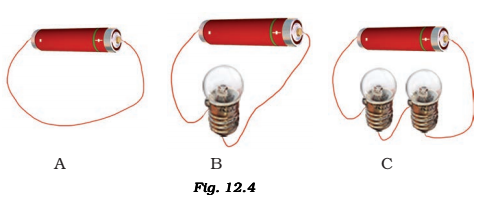
15. In which of the following circuits A, B and C given in fig 12.4, the cell will be used up very rapidly?

NCERT Exemplar Solutions for Class 6 Science Chapter 12- image 4


16. Correct the following statements.                                  (2)

(i) The colour of the shadow of an object depends on its colour of the object.
(ii) Transparent objects allow light to pass through them partially.

17. An electric bulb is connected to a cell through a switch as shown in fig 12.7. When the switch is brought in ‘ON’ position, the bulb does not glow. What could be the possible reason/s for it? Mention any two of them.                                                     (3)

Tuesday, November 9, 2021

PRACTICE WORKSHEET, CH 11, CLASS 6

A. Multiple Choice Questions

1. Shadows form because:
(a) opaque objects reflect light
(b) opaque objects do not allow light to pass through them
(c) light travels in one direction from a source
(d) light bends around an opaque object

2. objects do not allow any light to pass through them.
(a) Transparent
(b) Translucent
(c) Opaque
(d) Luminous

3. Which of the following is a non-luminous body?
(a) Moon
(b) Sun
(c) Bulb
(d) Burning candle

4. The colour of a shadow is :
(a) black
(b) green
(c) grey
(d) cannot say

5. The speed of light in vacuum is :
(a) 3 × 10⁸ m/sec
(b) 2 × 10⁹ m/sec
(c) 1.5 × 10⁸ m/sec
(d) none of these

B. Fill in the Blanks:

1. Light is a form of ……………………. .
2. A glowing tubelight is an example of …………………… source of light.
3. The shadow of an object is always of ………………. colour.
4. The …………………… is a luminous object.
5. Light travels in a ……………….. line.

C. State True or False:

1. The moon is a natural source of light. ……………….
2. Light always travels in a straight line. ……………….
3. Pinhole camera works on the principle of rectilinear propagation of light. ………………….
4. Stars are luminous bodies. …………………
5. Shadow of an object is formed in the direction. opposite to that of the light source. …………….

D. Match the following:

‘A’‘B’
1. Bricka. A natural source of light
2. Tubelightb. Region of partial darkness
3. Sunc. Shadow cast by heavenly bodies
4. Eclipsed. An opaque object
5. Penumbrae. An artificial source of light
E. Write the letter in the blanks given below with the help of corresponding hints.

1. T _ _ _ S _ _ _ _ _T.
Hint: Through these objects, we can see but not very clearly.

2. _ _M _ N _ _ S.
Hint: Sun is in this category of sources of light.

3. S _ R _ _ _.
Hint: We can’t obtain an image without this.

4. R _ _ _ C _ _ _ _ .
Hint: Mirror gives us clear images because of this phenomenon.

Class 8 Chapter 12 Friction, NCERT Solutions

 1. Fill in the blanks.

(a) Friction opposes the _____________ between the surfaces in contact with each other.

(b) Friction depends on the _____________ of surfaces.

(c) Friction produces __________.

(d) Sprinkling of powder on the carrom board ________ friction.

(e) Sliding friction is ___________ than the static friction.

Soln:

(a) Friction opposes the motion between the surfaces in contact with each other.

(b) Friction depends on the nature of surfaces.

(c) Friction produces heat.

(d) Sprinkling of powder on the carrom board reduces friction.

(e) Sliding friction is lesser than the static friction.

2. Four children were asked to arrange forces due to rolling, static and sliding frictions in a decreasing order. Their arrangements are given below. Choose the correct arrangement.

(a) rolling, static, sliding

(b) rolling, sliding, static

(c) static, sliding, rolling

(d) sliding, static, rolling

Soln:

Answer is (c) static, sliding, rolling

3. Alida runs her toy car on dry marble floor, wet marble floor, newspaper and towel spread on the floor. The force of friction acting on the car on different surfaces in increasing order will be

(a) wet marble floor, dry marble floor, newspaper and towel.

(b) newspaper, towel, dry marble floor, wet marble floor.

(c) towel, newspaper, dry marble floor, wet marble floor.

(d) wet marble floor, dry marble floor, towel, newspaper

Soln:

Answer is (a) wet marble floor, dry marble floor, newspaper and towel.

4. Suppose your writing desk is tilted a little. A book kept on it starts sliding down. Show the direction of frictional force acting on it.

Soln:

When book slides down on the desk, a frictional force acts between the book and the surface of the desk. The direction of the friction force on the book is opposite to the direction of its motion and acts in an upward direction. It is shown in the diagram below.

direction of frictional force acting on Tilted writing board

5. You spill a bucket of soapy water on a marble floor accidently. Would it make it easier or more difficult for you to walk on the floor? Why?

Soln:

It is possible to walk on the floor because of the friction present between our feet and the ground. For walking, we push the ground in a backward direction with our feet. The force of friction pushes it in the forward direction and allows us to walk. The force of friction decreases between the ground and the feet when there is soapy water spilt on the floor. Hence, it becomes difficult to walk on the soapy floor.

6. Explain why sportsmen use shoes with spikes.

Soln:

Sportsmen use shoes with spikes because of the better grip given by spikes while running. This is because the force of friction between the shoes and the ground increases with the help of spikes.

7. Iqbal has to push a lighter box and Seema has to push a similar heavier box on the same floor. Who will have to apply a larger force and why?

Soln:

Due to the interlocking of the irregularities on the two surfaces in contact, the force of friction arises. On the floor when a heavy object is placed, the interlocking of irregularities on the surface of the box and floor become strong. This is because the two surfaces in contact are pressed harder. Hence, more force is required to overcome the interlocking. Thus, to push the heavier box, Seema has to apply greater force than Iqbal.

8. Explain why sliding friction is less than static friction

Soln:

When irregularities present in the surfaces of two objects in contact get interlocked with each other, friction come into play.  The time given in sliding for interlocking is very small. Thus, interlocking is not strong. Therefore, less force is required to overcome this interlocking. Due to this reason, sliding friction is less than static friction.

9. Give examples to show that friction is both a friend and a foe.

Soln:

Advantages of the friction

a) Due to friction, we are able to walk.

b) We are able to write because of the friction between the tip of the pen and paper.

Disadvantages of friction

a) Because of friction, the tires and soles of shoes wear out.

b) Friction produces heat between different parts of the machines. This can damage the machines.

10. Explain why objects moving in fluids must have special shapes.

Soln:

When a body moves through a fluid, it experiences an opposing force which tries to oppose its motion through the fluid. This opposing force is known as the drag force. This frictional force depends on the shape of the body. By giving the objects a special shape, the force of friction acting on it can be minimized. Hence, it becomes easier for a body to move through the fluid.

Class 6 Science Chapter 10 Motion and Measurement of Distances

 1. Give two examples each, of modes of transport used on land, water and air.

Solution:

Land- Train, Bus

Water- Ship, Boat

Air- Helicopter, Aeroplane

2. Fill in the blanks:

(i) One metre is ______________ cm.

(ii) Five kilometre is ______________ m.

(iii) Motion of a child on a swing is ______________.

(iv) Motion of the needle of a sewing machine is ______________.

(v) Motion of wheel of a bicycle is______________.

Solution:

(i) One metre is 100 cm.

(ii) Five kilometre is 5000 m.

(iii) Motion of a child on a swing is periodic.

(iv) Motion of the needle of a sewing machine is periodic.

(v) Motion of the wheel of a bicycle is circular.

3. Why can a pace or a footstep not be used as a standard unit of length?

Solution:

Pace or a footstep cannot be used as a standard unit of length because it varies from person to person.

4. Arrange the following lengths in their increasing magnitude: 1 metre, 1 centimetre, 1 kilometre, 1 millimetre.

Solution:

1 millimetre, 1 centimetre, 1 metre, 1 kilometre

5. The height of a person is 1.65 m. Express it into cm and mm.

Solution:

1.65= 165 cm = 1650 mm

6. The distance between Radha’s home and her school is 3250 m. Express this distance into km.

Solution:

1km = 1000 m

Hence 3250 m = 3.25 kms

7. While measuring the length of a knitting needle, the reading of the scale at one end is 3.0 cm and at the other end is 33.1 cm. What is the length of the needle?

Solution:

Length of needle = 33.1 – 3 = 30.1 cm

8. Write the similarities and differences between the motion of a bicycle and a ceiling fan that has been switched on.

Solution:

Similarities – The blades of a fan and the wheels of a bicycle shows circular motion

Differences- Bicycle move in rectilinear motion, but the fan does not move in rectilinear motion.

9. Why would you not like to use a measuring tape made of an elastic material like rubber to measure distance? What would be some of the problems you would meet in telling someone about a distance you measured with such a tape?

Solution:

An elastic measuring tape will not give accurate measurement as it stretches in length and reduces in size when stretched. When we express measurement taken with elastic tape, we have to tell whether the tape was stretched. If yes, how much. Hence it is very difficult to tell the measurement taken from an elastic tape.

10. Give two examples of periodic motion.

Solution:

a) A needle of a sewing machine

b) Pendulum

Class 6 Science Chapter 11, NCERT Back Exercise

 1. Rearrange the boxes given below to make a sentence that helps us understand opaque objects.

Opaque objects puzzle

Solution:

The given boxes can be rearranged to form ‘Opaque Objects Make Shadows’ as shown below

Opaque objects puzzle

2. Classify the objects or materials given below as opaque, transparent or translucent and luminous or non-luminous:

Air, water, a piece of rock, a sheet of aluminum, a mirror, a wooden board, a sheet of polythene, a CD, smoke, a sheet of plane glass, fog, a piece of red hot iron, an umbrella, a lighted fluorescent tube, a wall, a sheet of carbon paper, the flame of a gas burner, a sheet of cardboard, a lighted torch, a sheet of cellophane, a wire mesh, kerosene stove, sun, firefly, the moon.

Solution:

Opaque:  A piece of rock, a sheet of aluminium, a mirror, a wooden board, a CD, an umbrella, a wall, a sheet of carbon paper,  a sheet of cardboard.

Transparent: Air, water, a sheet of plane glass.

Translucent: A sheet of polythene, smoke, fog, a sheet of cellophane, a wire mesh.

Luminous: A piece of red hot iron, a lighted fluorescent tube, the flame of a gas burner, a lighted torch, sun, firefly, kerosene stove.

Non – luminous: Air, water, a piece of rock, a sheet of aluminium, a mirror, a wooden  board, a sheet of polythene, a CD, smoke, a sheet of plane glass, fog, an umbrella, a wall, a sheet of carbon paper, a sheet of cardboard, a sheet of cellophane, a wire mesh, moon.

3. Can you think of creating a shape that would give a circular shadow if held in one way and a rectangular shadow if held in another way?

Solution:

Yes,


4. In a completely dark room, if you hold up a mirror in front of you, will you see a reflection of yourself in the mirror?

Solution:

No, in a dark room, a mirror reflection of the image will not be shown as the light will not fall on the mirror to reflect the image due to darkness.