
Tuesday, June 23, 2020

Monday, June 22, 2020
PRACTICE QUESTIONS OF RDT (CH 1) Class 12, BIOTECH
2 Marks questions:
1. What are expression vectors? What kind of promoter should be used in such vectors?
2. Generally, eukaryotic hosts are preferred to express eukaryotic proteins. Why?
3. Why viral vectors are ideal to transform host cells with suitable transgene?
4. Starting from double stranded DNA suggest a strategy for obtaining large amounts of pure single stranded DNA for sequencing purposes.
4. Starting from double stranded DNA suggest a strategy for obtaining large amounts of pure single stranded DNA for sequencing purposes.
3 Marks questions:
1. Why do we use Taq polymerase in PCR? What is the importance of primers in the process of PCR? If we started with 5 molecules of template DNA, how many molecules will we get after 35 cycles of PCR?
2. In Southern Blotting, why do we bake nitrocellulose membrane after blotting? Why this technique is called blotting technique? Name a technique used to locate RNA in a gel?
3. Schematically illustrate various steps involved in creation of genomic library.
5 Marks questions:
1. Explain with a suitable diagram, the steps and principles involved in Sanger's method of DNA sequencing.
2. Discuss any 5 methods of introduction of rDNA into host cells.
3. Write a descriptive account on SDM.
Sunday, June 21, 2020
Saturday, June 13, 2020
PICTURE BASED QUESTION (CLASS 7, CH 1)
1. Name the process shown here. What are the various raw ingredients utilized in this process?

2. Name the opening shown here and the two cells which are around this opening

3. Why these leaves have different colours?

4. Dear student can you explain why the covered portion of leaf is colourless?

5. Name the parasite shown in the given diagram and define parasite.

6. Differentiate between the three modes of nutrition shown here :


2. Name the opening shown here and the two cells which are around this opening
3. Why these leaves have different colours?
4. Dear student can you explain why the covered portion of leaf is colourless?
5. Name the parasite shown in the given diagram and define parasite.
6. Differentiate between the three modes of nutrition shown here :
RECOMBINANT DNA TECHNOLOGY (CH-1, CLASS-12), 1 MARK QUESTIONS
1. In RDT, what is the advantage of using vectors with polylinkers and MCS?
2. What are expression vectors?
3. What kind of promoter should be used in such vectors?
4. What do you understand by the word insertional inactivation?
5. Name any two visual methods of screening transformed bacterial cells.
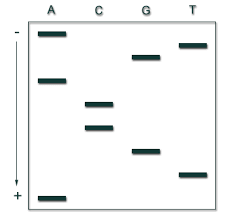
6. Why the sequence we get from autoradigram is complementary to the original sequencde?
7. In the following DNA fingerprinting gel autoradiogram, which person is most likely the father of the child?

8. For identifying the fragment TTATGCCGCGATTCATACTAT, after restriction digestion genomic DNA, which probe will you use?
a. ATGCCGCGA
b. GGCGTAAGT
c. TCATACTAT
d. TTAGCTATA
9. Write the sequence of the original DNA strand of this autoradiogram where each well is showing ddNTP utilized.
10. What do you mean by the word pallindrome?
11. Why type II R.E. are most commonly exploited in RDT?
12. Name the specific enzyme shown here and its specific function.
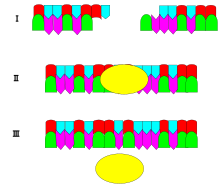
13. Name the specific enzyme shown here and its specific function.

14. Why Yep is consider as shuttle vector?
15. Following diagram shows the infection by a M13 virus to the bacterial host where it completes its lifecycle. What is the importance of ssDNA and dsDNA of M13 shown here in RDT?

16. Why E.coli is not a suitable host for expression of eukaryotic proteins?
17. Name any two plant and animal viral vectors
18. What is the function cos site of lambda DNA?
19. Which method of introduction of rDNA into host cell is depicted here"

20. How many DNa fragments will you get after completion of 12 cycles when initially 3 copies of DNA are taken as template.
21. At what temperature annealing in PCR takes place?
22. What is blotting in Southerrn Hybrdization?
23. Write any two advantages of the following library:

24. Write the principle of the techinque shown below:

25. Why cDNA lacks introns?
2. What are expression vectors?
3. What kind of promoter should be used in such vectors?
4. What do you understand by the word insertional inactivation?
5. Name any two visual methods of screening transformed bacterial cells.
6. Why the sequence we get from autoradigram is complementary to the original sequencde?
7. In the following DNA fingerprinting gel autoradiogram, which person is most likely the father of the child?
8. For identifying the fragment TTATGCCGCGATTCATACTAT, after restriction digestion genomic DNA, which probe will you use?
a. ATGCCGCGA
b. GGCGTAAGT
c. TCATACTAT
d. TTAGCTATA
9. Write the sequence of the original DNA strand of this autoradiogram where each well is showing ddNTP utilized.
10. What do you mean by the word pallindrome?
11. Why type II R.E. are most commonly exploited in RDT?
12. Name the specific enzyme shown here and its specific function.
13. Name the specific enzyme shown here and its specific function.
14. Why Yep is consider as shuttle vector?
15. Following diagram shows the infection by a M13 virus to the bacterial host where it completes its lifecycle. What is the importance of ssDNA and dsDNA of M13 shown here in RDT?
16. Why E.coli is not a suitable host for expression of eukaryotic proteins?
17. Name any two plant and animal viral vectors
18. What is the function cos site of lambda DNA?
19. Which method of introduction of rDNA into host cell is depicted here"
20. How many DNa fragments will you get after completion of 12 cycles when initially 3 copies of DNA are taken as template.
21. At what temperature annealing in PCR takes place?
22. What is blotting in Southerrn Hybrdization?
23. Write any two advantages of the following library:
24. Write the principle of the techinque shown below:
25. Why cDNA lacks introns?
Subscribe to:
Posts (Atom)