Wednesday, September 15, 2021

CCT Practice Paper, Class VIII SCIENCE, Ch 8


Basic features of cells


All cells are bounded by a plasma membrane. The semifluid substance within the membrane is the cytosol, containing the organelles. All cells contain chromosomes which carry genes in the form of DNA. All cells also have ribosomes, tiny organelles that make proteins using the instructions contained in genes. A major difference between prokaryotic and eukaryotic cells is the location of chromosomes. Eukaryotic cell- chromosomes are contained in a membrane-enclosed organelle, the nucleus. Prokaryotic cell- the DNA is concentrated in the nucleoid without a membrane separating it from the rest of the cell.


Fig.1 Bacteria Problems with Cell Size


In general, eukaryotic cells are much bigger than prokaryotic cells: Most bacteria are 1-10 microns in diameter. Eukaryotic cells are typically 10-100 microns in diameter. A large cell requires "much more" in terms of the cellular components. Uptake from the environment is also a problem for large cells: there is less surface area compared to the volume. Distribution of nutrients from one portion of a large cell to another is also a problem, simply because of the distance required for the nutrients to travel. 

Fig 2
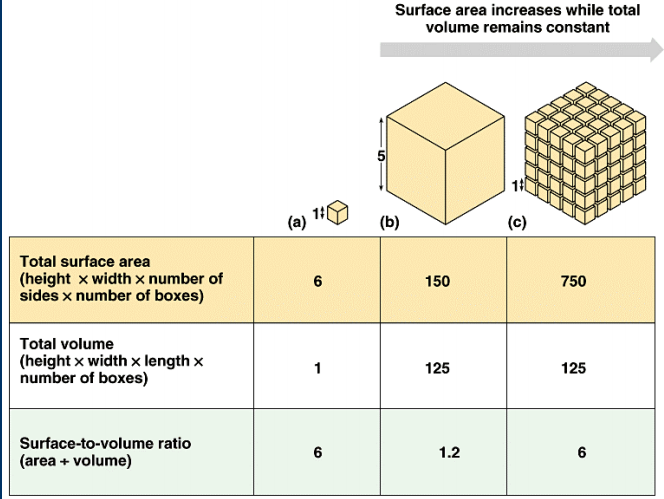

Thus most cells are small: sufficient surface area to accommodate the volume. Larger organisms do not generally have larger cells than smaller organisms, - just simply more cells.


Question 1.What will be the size range of bacteria in millimeter?  (1 micron= 10-3 mm)

  1. 103mm-102mm

  2. 10-3mm-10-2mm

  3. 102mm-103mm

  4. 10-2mm-10-3mm


Question 2 .(a)The cells can be Prokaryotic or Eukaryotic .Fig. 1 explains the structure of which type?

                      -------------------------


Question 3 Why cells are preferred to be of small size? Write two reasons.

                       -------------------------------------------------------------

                       -------------------------------------------------------------


Question 4 The DNA present in the cell signifies chemical nature of--

  1. Genes

  2. Chromosomes

  3. Ribosomes

  4. Prokaryotes

Choose the correct option-

  1. a and c

  2. b and d

  3. a and b

  4. c and d


Tuesday, September 7, 2021

GREEN OLYMPIAD BY TERI

 As per the letter recieved by KVS it is for the information of students that to inform that TERI is going to organize an Environmental theme based 'Green Olympiad 2021' in online mode is to be conducted by on  10-21 November 2021 & 6-17 December 2021 for the students from classes IV toXII. Registration for the competition is to be done from 15 August to 30th September 2021on the link given below. :

www.teriin.org/olympiad

It is requested that the Principals of the Vidyalayas under the region may be informed toencourage the students to participate in the said competition on VOLUNTARY BASIS.

FOR INDIVIDUAL REGISTRATION YOU CAN VISIT 

https://www.teriin.org/olympiad/registration/iregistration.php


Monday, September 6, 2021

Solutions of NCERT Exemplar Solutions for Class 6 Chapter 8 – Body Movement

 1. Solution:

(a): (i) and (iii)

Bones form the structural framework of a body called a skeleton. The skeleton along with muscles helps our body parts to move. Bones are hard and cannot bend on their own. The joints help the body in moving.

Muscles are like elastic bands which are attached to the bones by means of tough connecting bands called tendons. Muscles help in the movement of bone through pull/contraction. Bones are wrapped up by muscles.

2. Solution:

(c): Upper jaw and skull

Upper jaw and skull have immovable joints since they are fixed joints.

3. Solution:

None.

Human beings and dogs have endoskeleton and muscles.

Snails have exoskeleton and muscles.

Earthworm does not have a skeleton. It has two sets of muscles one that makes it long and thin and the other that makes it fat. The contraction and relaxation of

these muscles help in movement.

4.  Solution:

(a): swim easily in water

Divers while swimming wears fin-like flippers on their feet because the muscle in the feet contracts, generating a curve on one side like a wave and the fin-like flippers move on the opposite direction exerting force against the surrounding water that pushes the underwater divers forward.

5. Solution:

(c): muscular foot

The muscular foot of the snail comes outside and attaches to the ground during locomotion. The foot of a snail has a special gland that produces slimy mucus to make slippery track to help it move smoothly.

6. Solution:

(b): Two

7. Solution:

Hinge joints present in our fingers help us to grasp the things like badminton racquet.

8. Solution:

If our backbone was made of one single bone we would not have been able to bend and twist our back.

9. Solution:

Here are the one-word answers:

  1. Ball and socket joint
  2. Bone
  3. Upper jaw with the skull
  4. Muscles
  5. Ribs
  6. Skeleton
  7. Pelvic bones
  8. Pivotal joint
  9. Cartilage
10. Solution:

(a) Hinge joint and ball and socket joint

(b) Pivotal joint

(c) Hinge joint

NCERT Exemplar Solutions for Class 6 Chapter 8 – Body Movement

 Multiple Choice Questions:

1. Which of the following parts of our body help us in movement?
(i) Bones
(ii) Skin
(iii) Muscles
(iv) Organs
choose the correct answer from the option below.
(a) (i) and (iii)
(b) (ii) and (iv)
(c) (i) and (iv)
(d) (ii) and (iii)

2. Which of the following joints is immovable?
(a) Shoulder and arm
(b) Knee and joint
(c) Upper jaw and skull
(d) The lower jaw and upper jaw

3. Which of the following organisms does not have both muscles and skeleton for movement?
(a) Dog
(b) Snail
(c) Earthworm
(d) Human being

4. Underwater divers wear fin-like flippers on their feet to
(a) swim easily in water
(b) look like a fish
(c) walk on the water surface
(d) walk over the bottom of the sea (sea bed).


5. A snail moves with the help of its
(a) shell
(b) bone
(c) muscular foot
(d) whole body.

6. How many muscles work together to move a bone?
(a) One
(b) Two
(c) Three
(d) Four

Very Short Answer Questions:

7. Name the type of joint of your hand which helps you to grasp a badminton racquet.

8. What would have happened if our backbone was made of one single bone?

9. Provide one-word answers to the statements given below.

  1. A joint which allows movement in all directions.
  2. A hard structure that forms the skeleton.
  3. Part of the body with a fixed joint.
  4. Help in the movement of the body by contraction and relaxation.
  5. Bones that join with chest bone at one end and to the backbone at the other end.
  6. A framework of bones which gives shape to our body.
  7. Bones which enclose the organs of our body that lie below the abdomen.
  8. Joint where our neck joins the head.
  9. Part of the skeleton that forms the earlobe.


10. Write the type of joint which is used for each of the following movements.
(a) A cricket bowler bowls the ball.
(b) A girl moves her head in right and left direction.
(c) A person lifts weights to build up his biceps.

Solutions of NCERT Exemplar Class 8 Chapter 11 – Force And Pressure

 1. Soln:

Answer is (a) Magnitude of force applied by A is greater than that of B.

Explanation:

The magnitude of force applied by A is bigger than that of B as a result of the block moves towards right i.e. towards B.

2. Soln:

Answer is (c) magnetic force alone

Explanation:

As electric current flows through the coil it behaves like an electromagnet which creates magnetic force. Hence the answer is magnetic force alone.

3. Soln:

The answer is (b) electrostatic force.

Explanation:

On combing the hair, comb and hair get oppositely charged due to electrostatic force.

4. Soln:

The answer is (d) Pressure at A < Pressure at B

Explanation:

Increase in water leads to an increase in depth.

5. Soln:

The answer is (d) either a magnetic or an electrostatic force

Explanation: when two objects are experiencing repulsive force because there may be an electrostatic force or a magnetic force.

6. Soln:

The answer is (b) force of friction

Explanation:

Force of attraction acts only when the bodies are in contact.

7. Soln:

Answer is (a) B and C

Explanation:

B and C are at the same level, hence pressure will be the same at B and C.

8. Soln:

Answer is (a) maximum in position A-C

Explanation:

Since the area of contact is minimum pressure will be maximum in A.

9. Soln:

Muscular Force.

10. Soln:

While walking we apply force on the ground.

11. Soln:

Towards the east.

12. Soln:

Answer is Magnetic force.

13. Soln:

Answer is Electrostatic force

14. Soln:

Force of gravity.

15. Soln:

Yes, the force of gravity act on dust particles.

NCERT Exemplar Class 8 Chapter 11 – Force And Pressure

Multiple Choice Questions

1. In Fig 11.1, two boys A and B are shown applying force on a block. If the block moves towards the right, which one of the following statements is correct?

(a) The magnitude of force applied by A is greater than that of B.

(b) The magnitude of force applied by A is smaller than that of B.

(c) The net force on the block is towards A.

(d) The magnitude of force applied by A is equal to that of B.


2. In the circuit shown in Fig.11.2, when the circuit is completed, the hammer strikes the gong. Which of the following force is responsible for the movement of the hammer?

(a) gravitational force alone

(b) electrostatic force alone

(c) magnetic force alone

(d) frictional force alone


3. During dry weather, while combing hair, sometimes we experience hair flying apart. The force responsible for this is

(a) force of gravity.

(b) electrostatic force.

(c) the force of friction.

(d) magnetic force.


4. Fig.11.3 shows a container filled with water. Which of the following statements is correct about the pressure of water?

Soln:


 (a) The pressure at A > Pressure at B > Pressure at C.

(b) The pressure at A = Pressure at B = Pressure at C.

(c) The pressure at A <  Pressure at B > Pressure at C.

(d) The pressure at A <  Pressure at B.


5. Two objects repel each other. This repulsion could be due to

(a) frictional force only

(b) electrostatic force only

(c) magnetic force only

(d) either a magnetic or an electrostatic force


6. Which one of the following forces is a contact force?

(a) force of gravity

(b) force of friction

(c) magnetic force

(d) electrostatic force


7. A water tank has four taps fixed at points A, B, C, D as shown in Fig. 11.4. The water will flow out at the same pressure from taps at

(a) B and C

(b) A and B

(c) C and D

(d) A and C


8. A brick is kept in three different ways on a table as shown in Fig. 11.5. The pressure exerted by the brick on the table will be

(a) maximum in position A-C

(b) maximum in position B

(c) maximum in position

(d) equal in all cases.


Very Short Answer Questions

9. A ball of dough is rolled into a flat chapatti. Name the force exerted to change the shape of the dough.


10. Where do we apply a force while walking?


11. A girl is pushing a box towards the east direction. In which direction should her friend push the box so that it moves faster in the same direction?


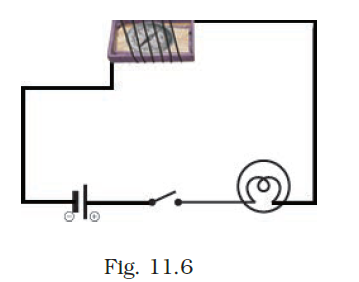
12., In the circuit shown in Fig.11.6, when the key is closed, the compass needle placed in the matchbox deflects. Name the force which causes this deflection.

NCERT Exemplar Class 8 Science chapter 11 Solutions fig 5


13. During dry weather, clothes made of synthetic fibre often stick to the skin. Which type of force is responsible for this phenomenon?


14. While sieving grains, small pieces fall down. Which force pulls them down?


15. Does the force of gravity act on dust particles?